
Feds Shouldn’t Enable Yet Another Bookie To Take Sports Bets
States trumped by "prediction markets" trading on federally-regulated futures exchanges

Just when I thought the odds against those trying to beat their gambling addiction couldn’t get any worse, a new way to bilk sports betters has emerged, bypassing the few protections offered by state regulation thanks to the backing of the self-interested Trump administration.
Just weeks after lamenting in my last blog about how the explosion in legalized sports betting is sending the number of gambling addicts soaring, a New York Times report called attention to “prediction markets” being launched over federally regulated futures exchanges, with contracts traded based on the outcome of sporting events.
Seeing the feds getting in on the action is an ironic turn of events, since it was a 2018 U.S. Supreme Court decision that opened the floodgates and allowed 39 states (and counting) to authorize sports gambling and quickly reap billions in new tax revenue. Up until then, such wagers were only legal in Nevada, which enjoyed exclusivity thanks to a grandfather exemption to a federal prohibition.
Leave it to the financial wizards of Wall Street to come up with a workaround that totally turns the tables. States have no power over federally sanctioned prediction markets. They can’t ban such contracts, collect taxes on trades, or impose restrictions to keep problem gamblers from getting in over their heads.
Prediction markets aren’t new, but activity has been generally limited to outcomes of political elections, economic indicators, and commodity prices. Their recent entry into the wide world of sports sent revenue soaring, with sports-related futures contracts accounting for three-quarters of the money “invested” through one leading platform, Kalshi.
Under another administration, such a transparently cynical attempt to avoid state oversight would likely have been derailed by the Commodity Futures Trading Commission (CFTC), but not in the Gilded Age of Trump, who has skin in the game. Kalshi named Donald Trump Jr. as a strategic advisor a week before his father’s inauguration, then began trading futures contracts on football playoff games three days after Trump Sr. took office.
In August, Don Jr. doubled down by having his venture capital firm invest in Polymarket, a rival of Kalshi, while joining its advisory board. Polymarket then received a green light to enter the U.S. market after a CFTC investigation into alleged recordkeeping and reporting violations initiated during the Biden administration was dropped and the agency under Trump decided in September to take no enforcement action.
In any normal world, such moves would raise conflict of interest questions, but not with today’s ‘anything goes’ Trump administration. It’s reminiscent of when Trump became an enthusiastic crypto booster and greased the wheels by lifting regulatory hurdles after he and his family started peddling the make-believe currency and related products.
Multiple states have initiated legal action, while U.S. senators from both parties have called on the CFTC to stop futures traders from circumventing local sports gambling laws. Good luck with that! Their odds of success are about one in a million! I don’t expect any more of a positive response to a letter from the National Council on Problem Gambling, asking the CFTC to at least require sports prediction markets to establish consumer safeguards, such as age restrictions and betting limits.
Kalshi justifies sidestepping local laws by insisting its platform is different from state-sanctioned sports gambling sites, which function more like casinos, where the house wins if a better loses. Prediction markets, on the other hand, merely facilitate the trading of futures contracts, collecting transaction fees for the service provided. It doesn’t matter to Kalshi who wins or loses, as both parties pay up regardless of the outcome.
But to me, gambling is gambling. Whether federal or state sanctioned, the last thing we need is another legal bookie tempting betting addicts, especially one able to do business in all 50 states (even those dwindling few, such as California, that don’t permit online sports betting). Talk about an unlevel playing field!
While state governments shriek and sue over federal infringement on their cash cow, Kalshi gleefully continues to expand its sports-related offerings by adding parlays to its futures options. For example, traders can exchange contracts (bets, in other words) dependent upon multiple teams winning games or multiple players scoring on the same day.
Both state-sanctioned sportsbooks and the emerging futures market are cashing-in big time on parlays, which a Washington Post report showed to be wildly popular with gamblers seeking more challenging bets and bigger payoffs, despite the odds of winning being so much worse. Kalshi has also broadened its reach dramatically by partnering with Robinhood, a popular online stock brokerage app.
I don’t see how prediction markets can be stopped or even slowed down by speed bumps without a change in the White House, which is probably why state-sanctioned online sportsbooks are looking to hedge their bets. If they can’t beat federally-regulated prediction markets, they might as well join them. FanDuel has already announced a partnership with a player in the derivatives market, CME Group, enabling customers to trade sports-related future events contracts.
There seems to be no end to the growth in legal sports gambling or the greed driving all the parties involved, particularly those in government who should be doing more to protect their constituents from financial ruin. Instead, they are doing everything in their power to fleece people of their hard-earned money.
The problem will likely become far worse as a new generation of betters are brainwashed into seeing gambling as a normal part of American sports, thanks to massive ad campaigns during sporting events and support from associated enablers.
One example is the NCAA, which is doing its part to boost gambling revenue by voting to allow Division I college athletes to legally bet on professional sports (pending approval by Division II and III). This is the height of hypocrisy since college ball is already “professional” now that schools are paying athletes directly and players collect millions in name, image, and likeness rights.
Money talks, as it always has, but that’s never been more true than now with the state and federal governments cashing in along with the bookies. The only sure bet is that fans will keep losing lots of money while more and more become gambling addicts, a lose-lose proposition for our society.
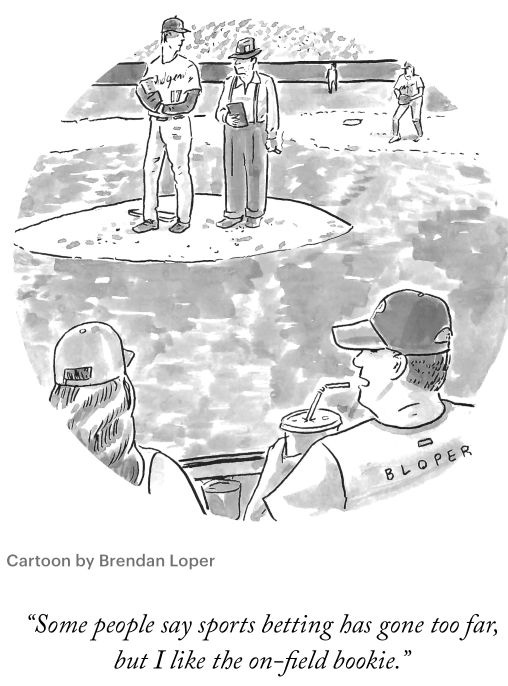
It might not be too long before bookies are free to roam the field, dugout, and clubhouse, as depicted in a recent cartoon from The New Yorker (see below).
(If you are struggling with gambling or fear you are addicted to betting, please seek help. You can reach out to the National Problem Gambling Helpline by calling 1-800-GAMBLER for free and confidential help. There are other groups offering help as well, such as Gamblers Anonymous.)
Great piece on a topic that would have been a major issue in the past. Now it's just petty corruption, I guess.
Would be good to have a backgrounder more broadly on why betting on sports in particular is a problem (why baseball is so set on preventing Pete Rose from being in the Hall of Fame, for example). And what the surrender to gambling might do to sports.
Don't know what to think. I just know I will never surrender my money to these people.